

When fire smoke settles into the Sacramento Valley, the sky can turn beige before the morning commute. Across our field inspections in smoke-affected homes, the families who cope best know which map to check and when to act. We’ve also found that most indoor smoke slips in through small gaps around the filter. This guide covers the Sacramento wildfire map tools we trust and how to protect your home’s air.
TL;DR
Use the AirNow Fire and Smoke Map for live smoke and PM2.5 over Sacramento, and CAL FIRE for fire size and containment. At AQI Orange (101+), close up the house, set your HVAC fan to “On,” and run a snug-fitting MERV 13 filter. In our field inspections, even a quarter-inch filter gap lets smoky air slip around it.
Key Takeaways
- The EPA and U.S. Forest Service AirNow map pairs regulatory monitors with corrected low-cost sensors.
- Plumes can sit high overhead, so trust the sensor nearest you.
- IndoorAirHub.com acts at AQI Orange (101+) rather than waiting for Red.
- The EPA recommends MERV 13 for smoke. It captures at least 85% of particles 1.0 to 3.0 microns.
- In our field inspections, a 0.25-inch gap around the filter lets smoke bypass the media.
Where Can I Find a Live Wildfire and Smoke Map for Sacramento Today?
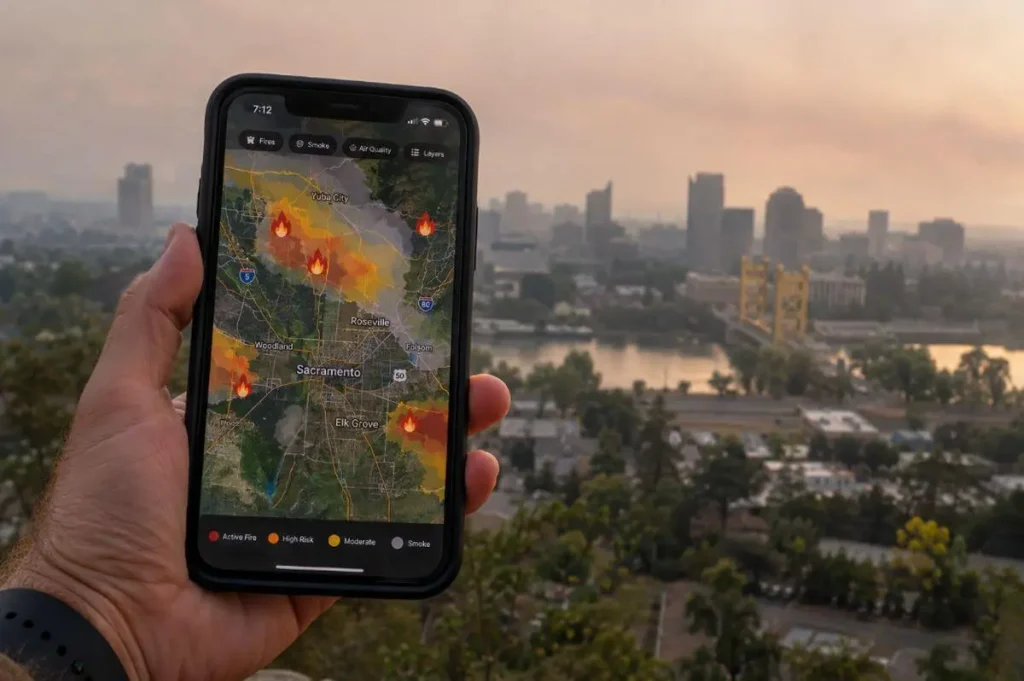
The best live Sacramento wildfire map is two free government tools used together. Our team checks these each morning in smoke season:
- AirNow Fire and Smoke Map: PM2.5, smoke plumes, and fires in one view.
- CAL FIRE Incidents: active fires with acreage and containment.
- NWS Sacramento: wind, Delta breeze, and inversion forecasts.
For a single local tab, Filterbuy, a U.S. air filter manufacturer based in Talladega, Alabama, publishes a live Sacramento map that adds AQI guidance to fire, smoke, and weather layers.
How Do I Read the Sacramento Smoke Map Without Misjudging the Risk?
Read the sensor dots first and the smoke shading second. Dots show measured ground-level air. Plumes show smoke satellites see, often thousands of feet up. The most common mistake we encounter is trusting a distant green dot, so use the sensor closest to your street.
According to the AirNow map FAQ, sensor data is EPA-corrected, plumes update every few hours, and fire icons are for general guidance only.
What Does the Sacramento Air Quality Index Mean During Wildfire Smoke?
Orange (101 to 150) is where Sacramento families should start acting. The EPA labels it “Unhealthy for Sensitive Groups.” The CDC lists children, pregnant people, and people with asthma, COPD, or heart disease as higher risk. We set that standard after seeing sensitive family members coughing well before the map turned red.
Here is how the EPA AQI categories translate at home, with more in our wildfire smoke AQI guide for homeowners:
- Green (0 to 50): Open windows.
- Yellow (51 to 100): Sensitive people watch for symptoms.
- Orange (101 to 150): Close up, set the fan to “On,” and use a clean room.
- Red (151 to 200): Everyone limits outdoor exertion.
- Purple and Maroon (201+): Stay inside with filtration running and follow county guidance.
Why Does Smoke Linger over the Sacramento Valley?
Sacramento sits between the Coast Range and the Sierra Nevada, and that bowl holds smoke. Overnight inversions trap it near the ground, so mornings often read worse. A steady Delta breeze can clear it by afternoon. Distant fires matter too. See how far wildfire smoke can travel.
How Do I Protect My Sacramento Home’s Indoor Air During Wildfire Smoke?
Seal the house and filter the air you recirculate. These steps follow EPA wildfire indoor air guidance:
- Close windows and doors at Orange.
- Install a MERV 13 filter, or the highest rating your system handles, and confirm a snug fit.
- Set the thermostat fan to “On.” In our experience, it’s the switch homeowners forget most.
- Run an ozone-free portable air cleaner with a published CADR in a closed clean room.
- Skip candles and frying while smoke is outside.
- Cover evaporative cooler intakes with 4-inch MERV 13 filters.
- Air out the house once the AQI drops to green or yellow.
What Do Our Field Inspections Show About Smoke Getting into Homes?
In our field inspections, most indoor smoke enters around the filter and through the return side of the system. What we see most:
- Loose or undersized filters. Measure the slot and order that exact size.
- Missing slot covers. Replace the cover or seal it with foil HVAC tape.
- Leaky return ducts. Have a technician seal the attic and garage returns before fire season.
- Smoke-loaded filters left in. Replace the filter once the smoke clears.
Which Air Filter Captures Wildfire Smoke Best?
MERV 13 is our minimum for any home, and a HEPA portable air cleaner adds room-level protection. Figures come from the EPA MERV rating chart and EPA guidance on air cleaners and air filters in the home:
- MERV 8: Handles dust and pollen, but not most smoke particles.
- MERV 13: Captures at least 85% of particles 1.0 to 3.0 microns. This is the EPA’s recommended level for smoke.
- MERV 14 to 16: More capture with more airflow resistance. See our MERV filter pressure drop chart.
- HEPA: Captures at least 99.97% of particles at 0.3 microns, mostly in portable units.
Before upgrading, we check how older blowers handle the added resistance.
Can a Box Fan Air Cleaner Help If I Don’t Own a Portable Air Cleaner?
Yes. In EPA testing, do-it-yourself box fan air cleaners matched a small commercial unit at reducing PM2.5. Following EPA’s research on do-it-yourself air cleaners, use a UL-marked 20-inch box fan made in 2012 or later. Attach a 20x20x1 MERV 13 filter with the airflow arrow toward the fan, and tape every edge. Replace filters once they load up, since dirty ones barely work.
How Can I Tell If Smoke Is Getting Inside My Home?
Put a low-cost PM2.5 sensor in your living area and compare it with the nearest outdoor reading. If indoor numbers climb with outdoor ones, smoke is getting in. EPA’s guide to understanding air sensor data notes sensors can also reveal your cleanest room. Treat readings as a guide, since low-cost sensors are less precise than regulatory monitors.
What If It’s Too Hot to Keep the Windows Closed?
Overheating is a health risk of its own. EPA advice to reduce your smoke exposure is to cool the home first and close up once it’s cool. If you can’t stay cool with the windows shut, seek shelter elsewhere. Without air conditioning, open windows when readings are lowest, then run an air cleaner.
When Should Sacramento Residents Prepare to Evacuate?
Know your evacuation zone before a fire starts. Evacuation orders come from local officials.
- Find your zone: Use Sacramento County’s evacuation zone maps.
- Get alerts: Register with Sacramento-Alert for emergency texts, calls, or emails.
- Pack a go bag: Include water, medications, documents, and pet supplies.
See why fractions of an inch matter in our comparison of a 20×22.25×2 filter versus a standard 20x22x2.
“The filter rating gets all the attention, but fit is where smoke protection is won or lost. A quarter-inch gap along one edge gives smoky air an easy path around the media, so measure the slot, not the old filter’s label.”
Essential Resources: Tools Every Sacramento Household Needs During Wildfire Season
Understand How Smoke Affects Your Family’s Heart and Lungs
The American Lung Association’s Wildfire Smoke and Lung Health guide explains how fine particles in smoke reach deep into the lungs and bloodstream. It also lists who faces the highest risk and which symptoms call for medical care.
Best for: Deciding how cautious your household needs to be on a smoky day.
Cut Your Smoke Exposure with Plain-Language Guides
AirNow’s Wildfire Guide Factsheets give short, practical guidance on reducing smoke exposure, filtering indoor air, and using air quality sensors. Other sheets focus on children, and on pets and livestock.
Best for: Quick, printable steps for the whole household.
Set Up a Clean Room That Keeps Smoke Out
The EPA’s guide to Create a Clean Room to Protect Indoor Air Quality During a Wildfire walks through choosing and sealing a room, then running filtration. It also shows how to stay cool without pulling in outdoor air.
Best for: Protecting sensitive family members when the AQI reaches Orange or worse.
Know What a Red Flag Warning Means Before Fire Weather Hits
The National Weather Service’s Wildfire Weather Safety page explains Red Flag Warnings and the wind and humidity conditions that let fires spread fast. It helps you treat a fire-weather forecast as your cue to get ready.
Best for: Planning ahead when dry, gusty conditions are forecast for the valley.
Prepare Your Home and Go Bag Before a Fire Starts
CAL FIRE’s Ready for Wildfire site covers go bags, defensible space, home hardening, and evacuation planning for California households. Its firePLANNER tool helps you build a family wildfire action plan.
Best for: Getting your home and family ready well before fire season peaks.
Get Sacramento County Alerts and Local Emergency Guidance
Sacramento Ready is the Sacramento County Office of Emergency Services hub for local emergency guidance and preparedness resources, including alert sign-up. It is where county officials post the information that tells you when to leave.
Best for: Staying connected to official evacuation warnings and orders.
Supporting Statistics: What the Research Says About Wildfire Smoke and Sacramento Homes
1. Wildfire Smoke Is Harder on the Lungs
- The stat: Each 10 µg/m³ rise in wildfire PM2.5 raised respiratory hospital admissions by 1.3% to 10%, compared with 0.67% to 1.3% for other PM2.5.
- The source: Aguilera et al., Nature Communications, 2021, via the NOAA Institutional Repository.
- Why it matters: It’s why we act at Orange instead of waiting for Red.
2. Camp Fire Smoke Hit Sacramento Hard
- The stat: The Sacramento-Del Paso monitor recorded PM2.5 of 228 µg/m³ on November 15, 2018.
- The source: The California Air Resources Board Camp Fire air quality analysis.
- Why it matters: Distance from a fire doesn’t guarantee clean air.
3. Filtration Works When the Filter Fits
- The stat: A MERV 13 filter plus a HEPA-type air cleaner held indoor PM2.5 to about 22% of outdoor levels, though filter bypass cut the MERV 13 to roughly MERV 10 performance.
- The source: A 2024 study of a Portland, Oregon home, via PubMed Central.
- Why it matters: It matches what our field inspections show about gaps.
Final Thoughts
Check AirNow and CAL FIRE each morning in fire season, and close up at Orange. Keep a snug MERV 13 in the slot before smoke arrives. Our team follows the same routine at home.
Frequently Asked Questions
What Is the Most Accurate Live Smoke Map for Sacramento?
The AirNow Fire and Smoke Map, which combines regulatory monitors with corrected sensors. Pair it with CAL FIRE for fire details, or Filterbuy’s live Sacramento map for everything on one local page.
Is It Safe to Exercise Outside in Sacramento When the AQI Is Orange?
Not for sensitive groups. Children, pregnant people, and anyone with asthma, COPD, or heart disease should move workouts indoors at Orange.
How Often Should I Replace My Air Filter During Sacramento Smoke Season?
Check it every week or two during smoke events and replace it when it looks dirty, as the EPA advises. Filters we pull after a heavy smoke week are often visibly gray.
Does a Small Gap Around My Air Filter Really Matter During Smoke Events?
Yes. In our field inspections, a 0.25-inch gap lets smoky air bypass the filter entirely. Measure the slot itself and confirm a snug fit.
Next Step: Clear the Smoke Smell from Your Home
When the haze finally lifts, the smell often lingers in fabrics and ductwork. Our guide to getting rid of wildfire smoke smell in your house covers ventilation and filter changes, along with cleaning fabrics and surfaces.
Glossary
Air Quality Index (AQI): The EPA’s 0 to 500 scale with six color-coded health categories.
PM2.5: Fine particles 2.5 micrometers or smaller, the main health concern in wildfire smoke.
Hazard Mapping System (HMS): NOAA’s satellite analysis of fire and smoke plumes.
MERV 13: An HVAC filter rating that captures at least 85% of particles 1.0 to 3.0 microns.
HEPA filter: A filter that captures at least 99.97% of particles at 0.3 microns.
Air bypass: Unfiltered air that flows around a filter through gaps in its slot.